
A couple of years back, I went to a conference on Utopian Studies. For the most part, it was, to be blunt, rather disappointing. Papers were presented wherein the limit of utopian thought was a liberal beneficence — less the great shock of the revolutionary New, but a more capitalist sense of “new and improved!”
Thankfully, that wasn’t everything. Midway through one of the afternoon sessions, I sat in a room with at most ten other people, watching a screen and listening to a paper by Darko Suvin. Suvin is an interesting and underappreciated figure in intellectual history: a Brechtian, East-European communist, who’s combination of poetry criticism, semantics, political history and Marxist philosophy is well worth exploring and he remains astonishingly productive even now, while well into his nineties. He’s most known for his work in science fiction, he was the founding editor of Science Fiction Studies. Mark Bould famously described his first essays as the “Suvin event” and his concept of the New and cognitive estrangement have become touchstones for SF criticism. However, the popularization of a concept often means that those who originated the concept tend not to be read very well. Indeed, Suvin himself makes the argument in a paper you can find here that to say something is new, or surprising is not the same thing as the Novum or doesn’t necessarily equate to cognitive estrangement.
After all, as Suvin (and before him, Bloch) argues, the Novum is not a feeling or experience of novelty but is a historical category that forms new meanings and — at core — presupposes a new kind of human consciousness. To put this another way, Suvin points out (entirely correctly) that to talk of the Novum is necessarily to talk about politics and revolutionary politics at that. Suvin’s later works haven’t achieved the same popularity in SF and utopian studies precisely because he’s gotten far more explicit about the current Social-Darwinist, anti-utopianism of our current politics (“we live in a utopia, it just isn’t ours” to quote China Mieville) and has turned increasingly to questions of political epistemology and the question of the philosophy of history. During his paper there was a line that stuck with me — “history is a poisonous swamp.” Suvin was trying to get away from the idea of teleological progress, that we would inevitably move towards some panglossian vision of progress or that there would inevitably be some kind of revolutionary change thanks to the iron laws of historical development. Suvina’s paper I linked above points out that the Novumn is not necessarily predetermined or even necessarily positive.
The New phase of capitalist history could be an intensification and acceleration of the annihilationist tendencies of the present leading into ecological collapse and exterminationism of the poor. The breakthrough of history is still an open question, still to be determined. When we left Suvin’s panel my friend Adam turned to me and said that “they should have called that session, some of us are still Marxists.” How are we to understand history? What can be done to get out of it?
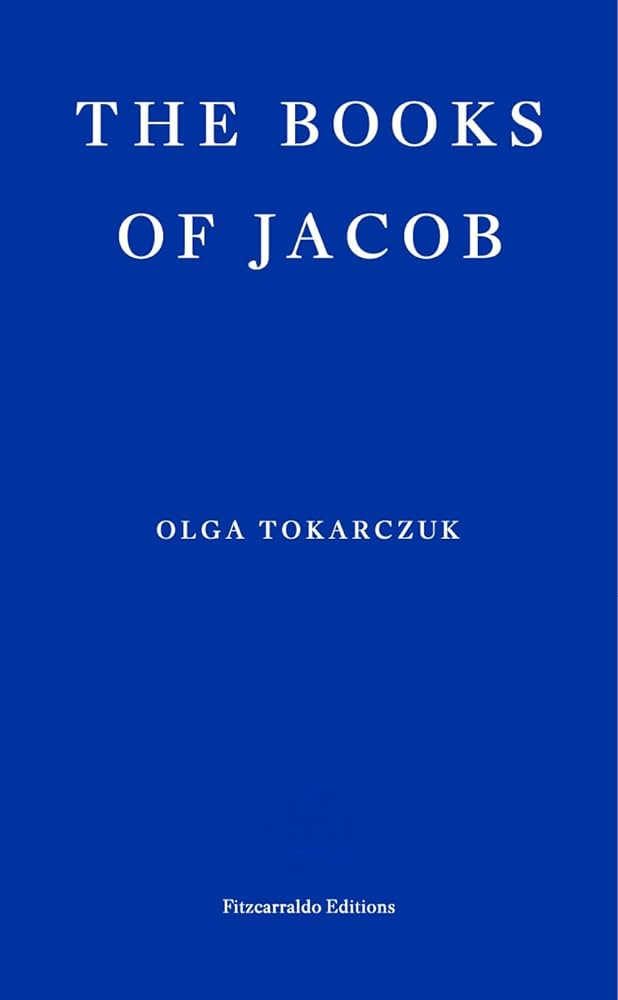
I finished reading Olga Tokarczuk, The Books of Jacob in the last couple of weeks and I think it engages with similar questions. What is to be made of history? Set in eighteenth century Poland, the novel follows the journey of Jacob Frank — the religious charismatic leader behind the Frankist movement. It sweeps across Poland, and Europe, following this strange and charismatic figure. Frank is imprisoned for heresy, encourages his Jewish followers to transgress moral and sexual boundaries and to convert from Judaism to Catholicism. Frank styles himself as the Messiah, referred to throughout the novel by his followers and acolytes as Lord. In her essay on the writing of the book, Tokarczuk describes Frank and his story as a “morose but unintentionally absurd comedy.” He’s a con man, a fraudster and an expert political schemer. But at the same time, his followers are theological and Kabbalist experts, traders and business owners and people who are genuine believers in Frank’s own Messianic possibility. In both the novel, and in history Frank’s political and financial work allowed him and his followers to integrate themselves into the upper echelons of Polish society — Frank himself died as a Baron, and many of the followers made themselves into part of society, an impressive act of self (re)creation in an era of intense anti-Semitism. The novel is a palimpsest of their letters, theological studies and Tokarczuk’s beautiful, poised and attentive narrative voice. Split across some 900 pages and 7 books, the novel opens with the detailed life and intellectual work of Father Benedykt Chmielowski, and ends with the book’s own narrator visiting Tokarczuk herself.
In both form and content the novel is explicitly concerned with the question of Messianic history, a shattering open of the teleological idea of an ordered unity of history. The Messiah is a break — an Event that fractures history creating a before and an after. Time becomes full of possibility, shattered out of its orderly sense of emptiness and shot through with both what was (Frank models himself on a previous Messiah) and what could be — but at the same time trying to connect moment one to another doesn’t proceed in a linear fashion. Think of the very end of Walter Benjamin’s Theses on the Philosophy of History: “the time of the now is shot through with chips of Messianic time.” So much of Benjamin’s philosophy of history is a blistering attack on what he saw as two sides of the same coin: on the one side, a smooth easy progression of capitalist progress, and on the other, what he saw as a passive social-democratic politics that saw utopia as an eschatological and teleological necessity. The crux of his critique rests in his Romanticism. Like many of his contemporaries, his critique harked back towards the past, but whereas the Romantic critique of modernity could often fall into a reactionary yearning for a prelapsarian and now tragically lost golden age, Benjamin saw history as something to go back to in order to undo the apparent victories of the past. You have to turn to the past, but only to turn back to the future (Michael Lowy points out Benjamin’s fondness for Janus and the two faces on one head are a good model for any kind of radical historiography). The future for Benjamin is not a destination — rather it is what we must go through to arrive at that which is always waiting to break in — not a lost past, but a revolution. Accept the naturalization of history and even the unquiet dead will not be safe, Benjamin writes, they will be forced back into the graves, their obliteration as much a law of the universe as gravity, and their struggles and still unrealised possibility wiped away. A will lead to B and then to C
To turn back to the novel, for all the plot is about Jacob Frank, there is little by way of access to Frank’s interiority. Rather what — or who — the reader is given is Frank’s grandmother, Yente. At the novel’s opening the elderly Yente is dying and, laying in a bed feverish and sick she swallows an amulet that suspends her between life and death. She is broken out of the chronology and becomes a floating observer over the great web of the novel’s history. Towards the end of the novel, Yente thinks of the characters that we as readers have watched grow up, fall in love, grow old and eventually die.
Even when people completely stop being able to feel their presence, when they can no longer be reached by any sign from them, the dead still traverse this purgatory of memory…Misers will take care of the living yet the dead are neglected by even the most generous. Yente feels something like tenderness towards them, when they graze her like a warm breeze — her, stuck here at the limit….And so, if Yente had ever professed any religion, after all the constructions her ancestors and her contemporaries had built up in her mind, her religion now is in her faith in the dead and their unfulfilled, imperfect miscarried or aborted efforts at repairing the world.
John Berger (also heavily influenced by Benjamin) wrote of the dead that “the dead inhabit a timeless moment of construction continually rebegun. The construction is the state of the universe at any instant,” and so there is a sense of some responsibility for those who are able to pay attention to them, So often throughout the book comes lines reminding the reader that Yenta saw. Yenta was there, floating over everything, it is Yenta who recalls, remembers and retells the story that she sees. Yente is the Benjaminian historian par excellence and by focalizing Yente so heavily, the novel resists the collapse of its history into the smooth and inevitable teleology. The novel is, as one review put it, as crowded as a painting by Bruegel, and to its credit it manages to weave together economic and political history with theological speculation and yet never succumbs to a sense of narrative inevitability. If the question for the politics and philosophy of history is how do we escape the poison swamp, then the question for the historical novel is how to get out of the gravity well that normative historicism posits? Tokarczuk’s answer, in her own words, is to be a heretic. In her essay on the writing of the novel, she puts it like this: “Alfred North Whitehead said that religion is the deepest form of loyalty to the world. I would add that heresy is the deepest form of protest against it. Every kind of heresy offers an idea for changing the world….the emergence of heresy is always revolutionary” Heresy is a theological category, but to change the world is a political act — perhaps what Benjamin wrote of historical materialism is also true of historical fiction:
The story is told of an automaton constructed in such a way that it could play a winning game of chess, answering each move of an opponent with a countermove. A puppet in Turkish attire and with a hookah in its mouth sat before a chessboard placed on a large table. A system of mirrors created the illusion that this table was transparent from all sides. Actually, a little hunchback who was an expert chess player sat inside and guided the puppet’s hand by means of strings. One can imagine a philosophical counterpart to this device. The puppet called ‘historical materialism’ is to win all the time. It can easily be a match for anyone if it enlists the services of theology, which today, as we know, is wizened and has to keep out of sight.
A final moment, towards the very end of the novel. We arrive in the early twentieth century and the small village of Korolówka. The book retells how Jews from the village hid in the local cave to escape the Nazi round ups, echoing how centuries earlier Frankists had hidden in the cave from the anti-Semites of their own time. Of course, given how the novel numbers its pages, this is also happening at the beginning of the novel too. The cave is in the shape of an aleph, the letter from which all is written. Tokarczuk comments on the true story of the Korolówka, in an afterword, pointing out that it is a reminder that ‘so many things remain quietly connected, and secondly, that history is the unceasing attempt to understand what it is that has happened alongside all that might have happened as well or instead.’ In an essay for Words Without Borders, and like the novel, also translated into English by Jennifer Croft, Tokarczuk writes of the increasing smallness of the world, in which digital technology has brought us into a pressing awareness of the finitude of existence. The entire essay is very long and well worth reading but there’s one final point about the nature of history, and the construction of narratives raised in it that chimes with Benjamin. Tokarczuk doesn’t just argue we need to get away from a sense of history that presupposes the naturalization of systems of domination, but we need to get out of an entire episteme. How do we find our way out of this particular poison swamp — I like Tokarczuk’s answer very much:
It strikes me that literature, as a never-ending process of telling stories about the world, has a greater capacity than anything else to show the world with a totality of the perspective of mutual influences and connections. Understood broadly, as broadly as possible, it is in its nature a network that connects and shows the enormity of the correspondence between all the participants of being. This is a very sophisticated and particular way of interpersonal communication, precise and at the same time total.
To embrace the precise totality of a particular vision of history calls attention to both our responsibility towards the past (the tenderness of Yente) and the understanding that even a failed heresy remains a potential doorway through which the New may arrive;

 thelitcritguy
One thought on “Raise Them Up From The Poison Swamp: Rupture and Heresy in The Books of Jacob”