
The multiplicity of interpretations to which the Commune has been subjected, and the multiplicity of interests which construed it in their favor, show that it was a thoroughly expansive political form, while all the previous forms of government had been emphatically repressive. Its true secret was this: It was essentially a working class government, the product of the struggle of the producing against the appropriating class, the political form at last discovered under which to work out the economical emancipation of labor. – Karl Marx, The Civil War in France
The news broke – a flash across the timeline. Peter Watkins, the veteran British film maker has passed away at the age of ninety. I would like to claim that this news was difficult, deeply sad for me to read but truthfully my response was slightly different. “Who?”
Seeing the obituaries and eulogies didn’t inspire grief, but it did make me curious – and so over the last week or two I’ve been working my way through as much of his writing as I can find plus his film work, much of which is a little difficult to get in the UK for reasons he spent his career inveigling against. I was curious, so I watched La Commune, Paris 1871 (2000), his final film, over the course of the last three days or so. I was curious at first, and now I am so deeply sad.
Watkins was best known for his docu-fiction approach to his films. Take Culloden, his 1964 film in which the brutal slaughter of the battle of Culloden is presented in the style of modern TV war reporting using mainly non-professional actors. Much of his career would be dedicated to a set of formal and dramatic concerns that depended on this documentary style, non-professional actors and a fundamentally collaborative approach to production. But these were not simply aesthetic choices. Watkin’s work is driven by a deep-seated political commitment, a modernist radicalism largely missing from mainstream media. His films were attempts to work out a formal aesthetic that would be contrary to the semiotic system of mainstream film and against the political implications that semiotic system carried within it. This is what Watkins called the mono-form in modern audio-visual media or, as he abbreviated it, MAVM. Watkins saw mainstream film as governed by a set of conventions with deliberate political effects. As he put it in a 2018 statement on the global media crisis:
The Monoform is like a time-and-space grid clamped down over all the various elements of any film or TV programme. This tightly constructed grid promotes a rapid flow of changing images or scenes, constant camera movement, and dense layers of sound. A principal characteristic of the Monoform is its rapid, agitated editing, which can be identified by timing the interval between edited shots (or cuts), and dividing the number of seconds into the overall length of the film. In the 1970s, the Average Shot Length for a cinema film (or documentary, or TV news broadcast) was approximately 6-7 seconds, today the commercial ALS is probably circa 3-4 seconds and decreasing. It is my belief that the excessive demands of these flashing images on our emotional and intellectual responses can lead to blurred distinctions between themes, and to a confusion in selecting and prioritizing our reactions (e.g., to the news scene of a bleeding body in a bombed area in Syria, which is followed by a commercial message, and sooner of later, by the image of a similarly bleeding body in a film or TV drama, etc.).
There are, Watkins thought, several catastrophic problems with the monoform. Not only does it not allow audiences the time and space to come to their own conclusions, but it went further, destroying the fundamentally participatory anthropology that rests at the heart of media interpretation. For Watkins the meaning of a text is worked out in a participatory process and thus, the audience must be given the time and space to enter the film and to understand themselves as both a constitutive part of it, and more widely of history. In an old YouTube clip I found while digging around for interviews or commentaries on his work, I found him talking about the importance of understanding oneself as a subject of history and that if were to understand oneself in this way, you raise the possibility that you can be more than just a subject of history, you can be an agent of it too. As he put in a 2001 interview: “our relationship to history is a very tenuous one. We’re on a cliff edge, slipping but holding on with our fingers, never more so than today.”
In contrast, this strict grid that breaks time and space in 90-120 minutes of rapid editing leaves audiences nothing to do – you become a passive spectator, primed only to accept the conclusion that the film is premised around. We shouldn’t even call this kind of media communicative, because communication necessitates a two-way exchange, it is inherently dialogic. In the monoform, the audience does not speak, and it does not think any more than is strictly necessary. I can imagine Watkins approving of Kubrick’s staging of the Ludovico Technique from A Clockwork Orange as a good allegory for the realities of the monoform. Or worse still, the proliferation of short form media, in which all images are subordinated to the endless ouroboros of algorithmic consumption and intensification. While in his writings he can occasionally come off as an obstreperous grouch about modernity, keen to settle some scores with the institutions of media, his anger is always undercut by a sense of grief and outrage of what the media could be, and what it could collectively do for us
Seen this way, Watkins’s aesthetic choice of fictionalised documentary is not just a matter of style, but both an attempt to get beyond the crude mimetic limitations of the monoform and to invite the audience into the text as participants. La Commune is also pedagogic – critics would deride it as didactic – and it’s this commitment to a pedagogical, participatory film practice that makes the film both democratic and modernist in a style only comparable to something Eisenstein’s Strike (1925). On the formal level, La Commune favours long sequence shots, ten minutes at a time without cuts, the camera plunging into the hundreds of people who crowd each scene. Alongside this, the wide-angle lens draws in the multiplicity to be the point of focus. There is, in a way that is completely engrossing, a collective and revolutionary subject up on screen. As a viewer you are thrown into the mix of the eleventh arrondissement, following the shifting social dynamics of the Communards, the wealthy, the army and the politicians at Versailles. Throughout the film the viewer is reminded repeatedly that the stuff of revolutionary struggle is not simply an act of deterministic teleology but a dynamic and embodied process in which the struggle is both theoretical and practical. It ended one way – yet it could have been otherwise and the implication is, as true as this was for that time and that place, it remains equally true for us today.
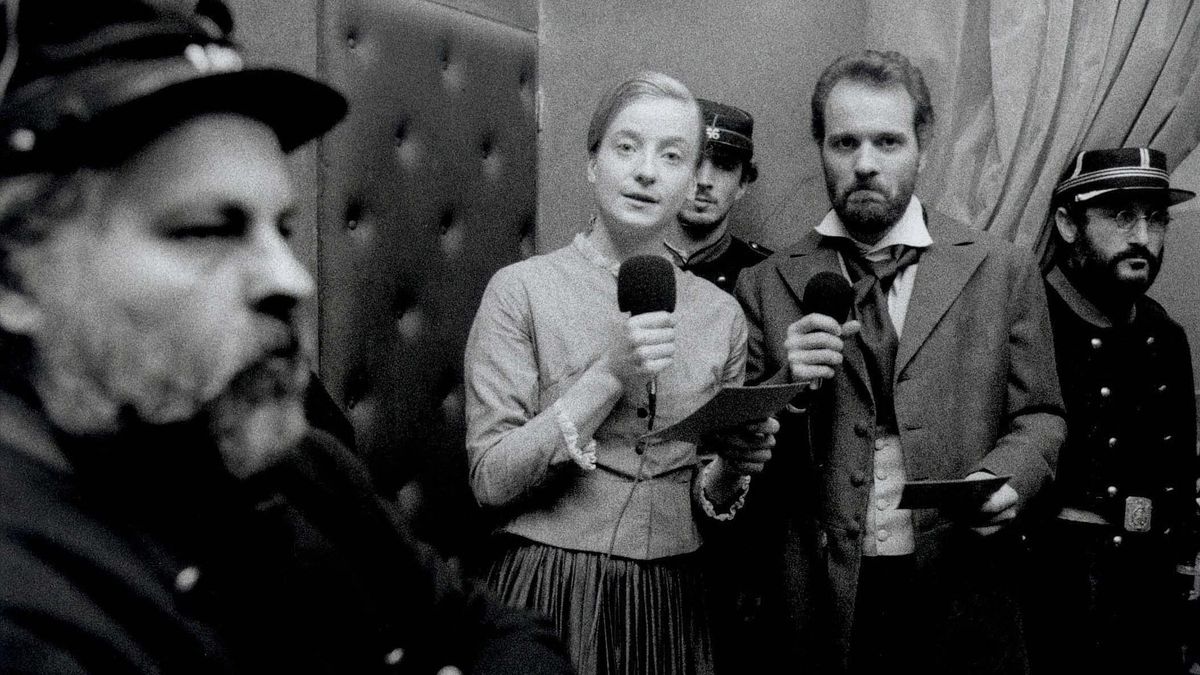
At the same time, in a way that is so audacious as to be jaw-dropping, the film draws heavily from Brecht. It opens with the actors on set (an abandoned warehouse) explaining to the camera what you are about to see. You are told that this isn’t real, but a presentation of facts from multiple points of view. Then a simple cut, and you are there – yet the roof of the warehouse is frequently and deliberately visible, actors will turn to camera and explain which of their lines have been drawn from historical sources and which are creative licence. The large crowds, many of whom are not professional actors, make contact with you as a watcher, staring back through time as the camera glides past their face. There is, deliberately, no hero to follow or villain to loathe, and the film is not constrained by what Watkins scathingly referred to as “the universal clock” of film time in which everything must run to a tight two hours.
Where that not enough, the film also poses a critique of media operations. There are, here in 1871 Paris, two competing television stations. The first, Versailles TV, represents the interests of the government. The semiotics it runs on are familiar. Experts behind a desk, a glib theme tune and a sombre, simplifying gloss on the events we’ve seen. This is media of the monoform – at no point does the revolutionary collective of Paris impact the strict time-space arrangement of their presentation, nothing that happens during the struggles of Commune undercuts the basic premises of how and why Versailles TV broadcast. It’s so telling that much of Versailles TV is seen only on the television screens of the wealthy, showing them events which are happening quite literally just outside their front door.
On the other hand, is Commune TV, in which the journalists are out on the streets. Their broadcast is dominated by questions, in which the citizens of Paris, particularly the working class are literally given a microphone and allowed to speak. It is history from below, revitalising the democratic legacies of the past’s struggle for emancipation with the democratising of the contemporary systems of the media. The revolutionary struggle unmakes the structuring system of the media for the journalists of Commune TV too. In a great moment in the first half of the film there is an active debate in which a print journalist and the two TV journalists question whether they should include more critical analysis of events as opposed to simply allowing the people to speak.
Collective actions are often quite literally interrupted by the Commune TV journalists running in for interviews to let people speak directly to the camera. One memorable moment during the film’s beginning hour is an interview with a working-class woman interrupted as soldiers arrive to attempt to confiscate the canon of Montmartre. It’s the working-class women of the area who halt the soldiers in their tracks causing them to turn on their commanding officers. History is shown to us as an active force – never settled, constantly in flux. It is so intellectually thrilling as to be almost exhausting. The radical democratic and modernist principles it shows, and which structured Watkin’s aesthetic commitments are baked into its production too. The film is almost six hours long and was shot mostly chronologically, something which greatly appealed to the mostly non-professional actors who enjoyed the chance to do what the film invites us to do: to reflect, to challenge their own preconceptions and absorb its lessons however the best saw fit. Some of the people cast were chosen precisely because they were conservative in their own politics because it was felt that doing so would both make the inter-class dynamics of the film more explicit and would challenge the performers too. None of this is abstract either – in the second half of the film the constructed historicity of the film draws an explicit connection between the events of the Paris Commune and the present condition, comparing the wages of the working classes then to wages and conditions in the late 1990s. The contradictions, exploitation and alienation have gone nowhere. It was a revolutionary moment: it could still be so.
Ultimately, watching it I couldn’t help but think of what Benjamin would say of Brecht’s work – the job of epic theatre is not so much to develop actions as to represent conditions
It was a film made in just thirteen days – thirteen days – and I can’t help but feel its existence is a miracle. I finished watching it and felt so furiously angry that I hadn’t seen it years ago, that Watkins hadn’t been introduced to me earlier, that I could have been in an art school and not heard his name. Yes, of course it would be easy and at least partly true to blame myself – there was nothing stopping me from having found his work ages ago but thinking about it, I was angry that the monoform had won, that algorithmic sorting of each of us has made all media seamless. As he wrote about the monoform:
What is the ideology that supports it? Perhaps we can’t give it a precise name, but we can certainly describe its intent , which is the opposite of any form of genuine two-way communication. The aim of the MAVM is to create a non-stop stream of impact points (surprises as one filmmaker called them) that will prevent viewers from being bored, and – crucially important – from experiencing a variety of reactions, let alone have time to reflect upon or query what is entering their subconscious.
I watched La Commune over a period of days – I think it should have been serialised on release but was broadcast late at night in the small hours of the morning. I watched utterly engrossed, angered, moved but maybe most importantly, gripped by the ambition of the film to combine the formal qualities of film in such a way as to leave space for me in it’s continuing work and thus, in the continuing work of the Paris Commune itself. In a way, Watkins reminds me greatly of John Berger. Like him, Berger was an art-school educated Brit who ended up leaving the country and settling in Europe, frustrated with the inability of the British cultural establishment to seriously reckon with their own formal, aesthetic and political complacency. Like Berger, Watkins is attentive to the very act of looking, the ways in which representation poses both political and formal problems that have to be taken seriously. And like Berger, Watkins emphasized a participatory and democratic hospitality for ordinary people. The article by Watkins, on the media crisis that I quoted above ends like this.
Another aspect of the marginalization against my work could be called ‘the wipeout’ – rather than name-call, this practice pretends that my films and media critique barely exist. Some months ago, I received an email from a Turkish writer and film enthusiast, who remarked that younger generations are not aware of my work. He also mentioned that he had never seen an article about my work either in Cahiers du Cinéma or the British film magazine Sight and Sound. I have often been told that young people have not heard of my films. I think this is particularly true in my own country…
He was right, and I wish he was not. But he leaves behind a tapestry of work that was also right: that film can be more than mere entertainment, that the rules of Hollywood impose a strangling ideological complacency and that film was, is and can be a place of democratic, radical experimentation in which all can learn and all can see a glimpse of a better kind of culture – even a new kind of social being.
Long live the social Republic.

 thelitcritguy
One thought on “The Democratic Modernism of Peter Watkins”