
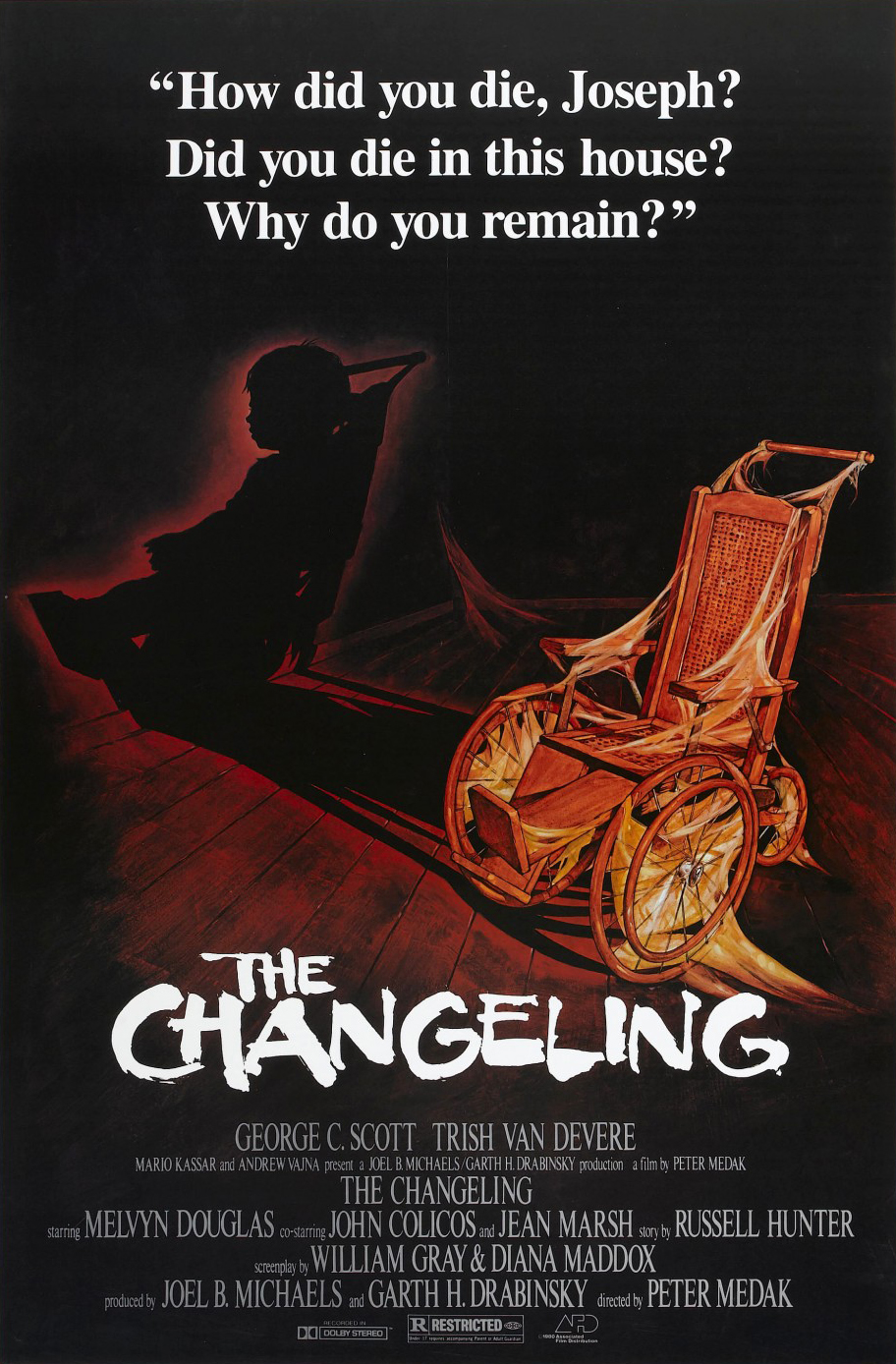
After suburbia, in the last part of the series I was interested in a more traditional haunted house film for this week’s installment. I was looking through lists for some underrated haunted house films and stumbled across The Changeling, a George C Scott vehicle from the 1980s.
It follows John Russell, played by Scott, a prestigious New York composer. After the tragic death of his wife and daughter, he moves from NYC to Seattle, taking up residence in a gloomy mansion. Almost as soon as he moves in he starts hearing unsettling noises and things escalate from there. There are some simple, tension laden practical effects, a great eerie score and the whole thing is anchored with Scott’s charismatic energy.
It turns out that a young boy called Joseph used to live in the house. The child was poised to inherit a large fortune should he have lived to twenty-one, but if he died earlier his family would lose its money. The child was also ill and disabled, and so the father, Richard, drowns his son in the bathtub and replaces his son with a child taken from a local orphanage — the titular changeling of the title. That child would grow up to inherit the wealth and power of his adopted family dynasty and become a local senator, under the name and identity of the dead child. He’s played rather wonderfully by double Oscar winner Melvyn Douglas in one of his final film roles before he passed away. Russell, for what it’s worth, seems to almost immediately leap to the idea of haunting, and takes to paranormal investigation with some gusto, along with the help of a woman from the local Seattle Historical Preservation Society, played by Scott’s real world wife, Trish Van Devere.
For all of the somewhat strange leaps the plot makes, it’s a surprisingly effective film – rather stylishly directed by Peter Mendak who would go on to direct a few episodes of Hannibal, House MD and The Wire. There are some wonderful choices in camera movements, as Mendak glides through the oppressive atmosphere of the mansion, slow pans and unnatural high or low angles leaving the mundane as something deeply sinister. There are multiple great subtle choices too – the early section of the film cuts between Russell, grief stricken in his empty New York apartment and match cuts to his dead daughter playing in the same space. By keeping the performer in the same location it literalizes the ways in which memory and place are interrelated. When he arrives in Seattle to visit his friend who works at the university, there is a brief shot of the family’s children, one of whom looks more than a little like his own long-gone child.
The story is a great reminder of the degree to which ghosts are always brought with us — it’s always the haunted who are haunted, and for all the reviews which complain that the plot makes a few leaps of logic to keep itself on track, there’s something very understandable about Russell immediately accepting that there must be something in the house, because to be alone would be so much worse. In fact he’s met with no real skepticism at all — shout out the university psychic research unit who turns up to conduct a seance and allow Russell to record it. The record also provides the indisputable proof of Joseph, desperately wishing for a father figure to come and help save him.
One of the interesting and slightly under expressed elements of the film is the dynamic nature of American property and how this is directly tied to a degree of political power. Joseph is born into the Carmichael family, who own land, multiple properties and have accrued vast amounts of wealth. At the Seattle Symphony, the orchestra are holding a fundraiser which is patronized by the scion of the Carmichael family – the now venerable Senator Joseph Carmichael. In short, property ownership is about power, and the film makes a clear link between the perpetuation of wealth and property with a specific kind of eugenic capitalism — in a sense it shows a very American iteration on the older idea of maintaining aristocratic family position through a careful managing of bloodlines and inheritance.
Carmichael strenuously denies Russell’s evidence that he’s adopted father is a murderer, and of course why wouldn’t he when it’s all worked out — to admit to the unspeakable would be a generational crisis of legitimacy, and would bring into question deeply American assumptions about meritocracy. There’s an additional interesting detail that the Carmichael family owns a lot of property but doesn’t live in it. It struck me as along with watching the film I’ve been reading Daniel Loick’s excellent short book The Abuse of Property. In it, Loick makes the argument that “something is being damaged through property, that it produces not use but abuse.” Just think of what happens to poor Joseph — it’s a well established idea that American capitalist patriarchs see their family as a kind of possession to be used and disposed of as they see fit. In fact, Loick goes further — it isn’t just that ownership is a problem, it’s that ownership isn’t about using things, it actually stops things being used as they should be. As he puts it, “every occupation is an act of repair.” The house Russell uses isn’t his — it’s owned by the Seattle historical preservation society which is underwritten by the Carmichaels. As Claire, Russell’s contact at the society explains, there were plans to turn it into a museum but there wasn’t money for that — perhaps it was more tax effective to leave it to slide into disrepair or rent it out in Seattle’s overheated rental market.
Reading Loick’s excellent book made me realise that for many the horror of the haunted house is that it throws the question of use and ownership into doubt. The ghost can occupy, use and even destroy property without ever owning it (indeed this is what happens at the end of the film). Furthermore, ownership is in liberal politics to be immutable and eternal making the ghost a kind of temporal squatter, driving down the speculative value of an asset and underscoring the very contingency and fragility of any notion of ownership as the unlimited exercise of agency and use. In a sense, housing can never escape its own historicity. The ghost can use property without ever owning it, and no matter how strenuously you try to secure private property the spectral possibility of abolition always lingers in the air.
The legal fiction of ownership is no guarantee for private property. Richard Carmichael saw himself as an owner, seeking to secure his and his children’s power as the owning class on a generational grounds. And yet the house falls and with it, so too does the Carmichael dynasty, hollow as the liberal fantasy of secured and inviolate private property. If every occupation is an act of repair, every haunting is an act of revolutionary possibility.

 thelitcritguy