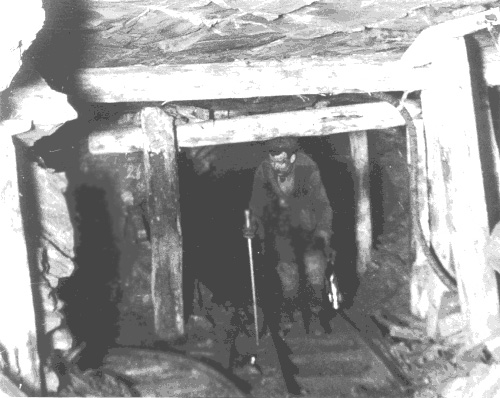
The Democratic Modernism of Peter Watkins

The multiplicity of interpretations to which the Commune has been subjected, and the multiplicity of interests which construed it in their favor, show that it was a thoroughly expansive political form, while all the previous forms of government had been emphatically repressive. Its true secret was this: It was essentially a working class government, the … Continue reading The Democratic Modernism of Peter Watkins

Amityville Postscript

The Haunt emerges from an almost yeat-long slumber. I don’t know if you’ve seen this or not, but Horror Vanguard put out our yearly Halloween special episode. A few years ago we decided to do something special for the first time and put out an episode that cracked the three hour mark. The following year … Continue reading Amityville Postscript

Raise Them Up From The Poison Swamp: Rupture and Heresy in The Books of Jacob

A couple of years back, I went to a conference on Utopian Studies. For the most part, it was, to be blunt, rather disappointing. Papers were presented wherein the limit of utopian thought was a liberal beneficence -- less the great shock of the revolutionary New, but a more capitalist sense of “new and improved!” … Continue reading Raise Them Up From The Poison Swamp: Rupture and Heresy in The Books of Jacob

Re-enchanting Zion: On Sarah Perry’s Enlightenment

I was, for better or worse, raised in the Methodist Church.  To try and explain precisely just what that means is difficult, as in many ways that iteration of the Methodist Church is no longer existent, or is found mostly in memories, kept alive by dwindling, gray haired congregations. The Methodism of the North of … Continue reading Re-enchanting Zion: On Sarah Perry’s Enlightenment

Blessed Are They That Mourn, For They Shall Be Haunted

I’ve been doing a series of events for A Primer on Utopian Philosophy (available now, order it here etc etc). What has been perhaps somewhat surprising is the extent to which Bloch’s philosophical project seems to resonate with people. In the midst of the bleak nightmare of modernity, Bloch’s unabashed philosophy of hope could easily … Continue reading Blessed Are They That Mourn, For They Shall Be Haunted

Now Time and the Not Yet

The connections and similarities between Bloch and Benjamin are still, I think, under-appreciated -- reflecting the wider lack of interest in Bloch’s work. The two were contemporaries, knew one another and had a deep appreciation for one another’s work and methods. Just on the surface there are some interesting polarities -- Bloch, the exegete; loquacious, … Continue reading Now Time and the Not Yet