
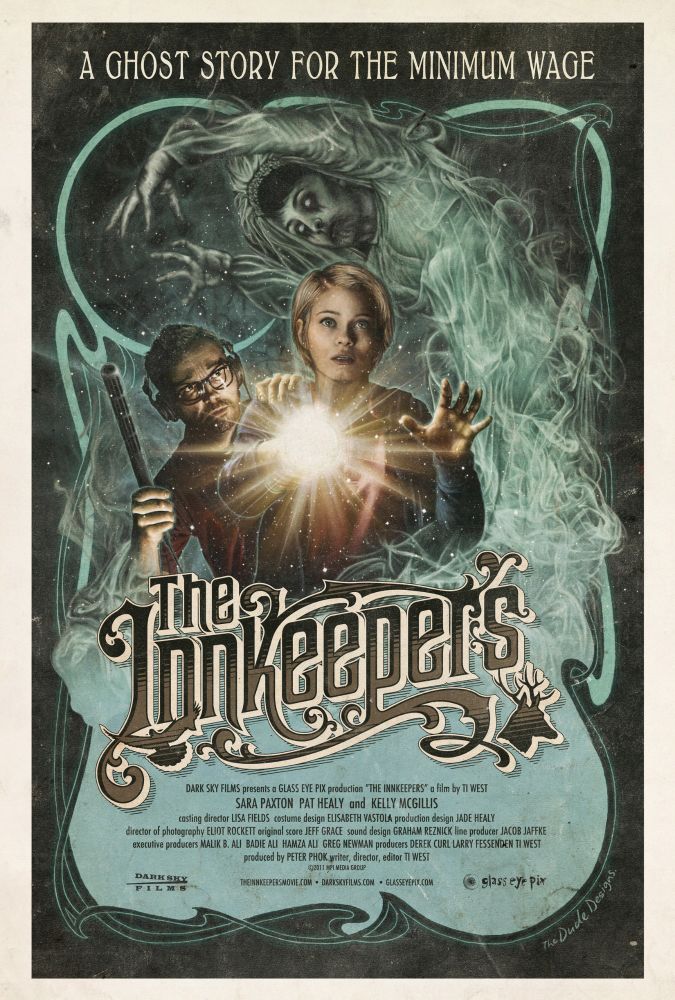
The last piece in the series (read it here, why not?) covered something of a classic so for this installement it seems appropriate to go for a more contemporary director who is clearly indebted to the form and aesthetics of older horror film. Who better than Ti West? However, I have to start with something of a caveat — I haven’t followed West’s career all that closely. I know the trilogy of X, Pearl and Maxxxine got a lot of buzz but when we covered those films over on Horror Vanguard I wasn’t particularly enamoured with them, finding them a kind of empty pastiche elevated into being watchable mostly thanks to the charisma of Mia Goth.
Happily, West’s earlier film, The Innkeepers, is both more interesting and more satisfying. It follows two minimum wage workers, Claire and Luke, seeing out a final shift at a decaying and soon to close hotel. Luke is trying to build a website to capitalize on the hotel’s reputation of being haunted, mostly because it seems to be a way of making a quick buck. Of course, over the night shift it turns out that not only are the ghosts real but the site of low paid, precarious and exploitative work is ultimately inescapable.
Much of what is novel about The Innkeepers as a haunted house movie is sociological rather than cinematic. On the formal level the moment to moment beats all work – there are a couple of effective jump scares and the whole thing comes to its conclusion with a fitting sense of inevitability. The hotel is a beautiful location with a suitably Gothic sense of faded elegance and West takes enough time to allow horror and dread to emerge slowly and invests in the characters so that they take on shape and coherence.
However, the obvious detail must have already jumped out. This isn’t a house – it’s a hotel. It was almost certainly a house once when it first opened. In fact, one of the early sequences in the film is a series of slow dissolves on the hotel’s exterior. We see it shift from a newly built and impressive home to an increasingly run down hotel. It decays and is remade as the world around it is too. The haunted house is no longer where the bourgeoise is made to confront their own anxieties around economics and domesticity. Now the haunted house is a decaying asset – the owner doesn’t even show up, being too busy on a trip to the Bahamas.
This leaves Claire and Luke behind – these two aren’t trying to protect their home, they are just trying to get through a shift. As characters they, like the hotel, have been indelibly shaped by the 2008 subprime mortgage crash. Their work is precarious, low paid, and mostly boring. Their conversations are the stuff of most shift work – talking shit, coming up with ways to pass the time and trying to find ways of winding up one another in ways that might be funny. Really the whole thing about looking for ghosts starts as a way of getting through night shifts. That’s certainly the case for Luke who sees the supernatural, particularly at the film’s opening, in primarily economic terms. He wants to find evidence for the hauntings to put on his rather charming Web 2.0 website, (it’s 2011, why not start a youtube channel, Luke?) But when it turns out that ghosts are real, it’s Claire who becomes the zealot and Luke runs from the hotel, confessing that he had never been a believer in the first place.
It isn’t just the two main characters either who seem to be trying to manage an increasing economic insecurity. There’s the single mother who turns up with her child for a few nights because she has nowhere else to go. She’s there because the hotel is cheap and because there isn’t any other option. There’s an older man who turns up insisting he needs to have a room on a floor that’s already been closed down but they relent because he too seems to be just trying to get through a rough night and hey, at this point, why turn away a paying guest, right? This sense of economic insecurity is enhanced by Lena Dunham turning up in a bit part as the millennial barista at the coffee shop next door, in a film that comes out less than a year before the first episode of Girls (perhaps the paradigmatic show of downwardly mobile millennial life). There’s even an old actor that Claire loves from a TV show who is now making a living as a medium/spiritualist. Presumably the work on TV dried up long ago but she still manages to make Claire feel small for her shitty dead-end job.
What’s really striking about the film is the degree to which it underscores the haunted house post recession as being essentially emptied of the domestic. After all, as Isaac Martin and Christopher Niedt highlight in their book Foreclosed America (2015) in the five years between 2007-2012, around 5% of American adults lost their homes – around ten million people. Claire and Luke don’t go home – and they don’t seem to have much of a life outside of work. Why would they – that’s expensive and if you’re on nights then what else are you going to do with your day other than sleep? The only home they have is an anonymous hotel room and the only reason they get that is so that they won’t be late for their next shift.
It’s Claire who ends up trapped in the hotel’s basement though – an asthma attack being given as the cause of her death. Of course, what really kills Claire is the combination of shitty work that means you get sick, a healthcare system that means you get sicker and the grinding effects of working poverty that means you can never get better or get a handle on chronic health conditions. The final shots of the film reveal her specter in another soon to be boarded up hotel room. There’s something deeply grim about the shift this film documents – if, in the nineteenth and twentieth centuries the haunted house was the site of women’s forcible confinement to the sphere of unpaid domestic labour, here the specter is condemned to an eternity in the service industry: one long night shift from which you can never clock out.


2 thoughts on “The Haunted House on Film Part Three”