
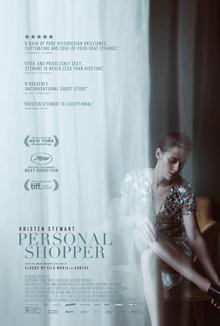
Last week was a less straightforward and conventional haunted house film, with its focus on the essential erasure or subsumption of the domestic into the service industry economy. I wanted to keep that theme going with this week’s entry, Oliver Assayas’s Personal Shopper. The story follows Maureen Cartwright, played by Kristen Stewart, who works as a personal shopper and assistant to a famous super model called Kyra. Maureen is also a medium or spiritualist of sorts, waiting for some sign from the other side from her recently departed twin brother Lucas. Lucas died because of a heart defect – the same defect that she herself suffers from.
Maureen’s life in Paris is marked by a paradox – she is constantly in motion and yet going absolutely nowhere, making no progress. The film follows her on a constant litany of errands for Kyra. Collecting jewelry, collecting high-end couture, zipping across Paris on a moped and being left messages from her absent boss who doesn’t even allow her assistant to try on the clothes. There’s a great small moment on a train: Maureen is on her way back from London to Paris and has to ask her boss to pay her in the right currency pointing out the practical possibility that her driver could just stop for her at the atm. There’s so much communicated in Stewart’s face, frequently framed very closely as she knocks back endless cups of cheap black coffee and cigarettes rather than food. She manages to get across her character’s bone-deep exhaustion, not just from a lack of sleep and tiresome, circular work but from having to manage the feelings and caprices of someone so much more powerful than she is. Kyra is late for a shoot, and the photographer is both frustrated and relieved. “Are you frightened of her,” asks Maureen. She’s a monster, comes the reply. At the same time, Kyra is both beautiful and successful. She has something that Maureen doesn’t. She has glamour. As John Berger puts it, in Ways of Seeing:
The happiness of being envied is glamour. Being envied is a solitary form of reassurance. It depends precisely upon not sharing your experience with those who envy you. You are observed with interest but you do not observe with interest – if you do, you will become less enviable. In this respect the envied are like bureaucrats; the more impersonal they are, the greater the illusion (for themselves and for others) of their power. The power of the glamorous resides in their supposed happiness: the power of the bureaucrat in his supposed authority.”
Maureen is a whirl of motion, an invisible worker of both professional and domestic labour — a boundary that is easy to cross given that the maintenance and projection of glamour depends upon an appearance of effortlessness. She moves seamlessly between Paris, London, Milan, New York, Kyra’s beautiful apartment and the ateliers and retailers of Paris. She slides seamlessly between the signs of luxury – Cartier, Chanel, YSL, the various high-end hotels across Paris. She is always in motion, and always invisible. Kyra only appears in the flesh a small handful of times — which is only correct. The glamorous aren’t supposed to be real – they are beautiful objects that others are paid to maintain.
At the same time, all of this motion leads nowhere. On the phone to a friend or a former lover who is now working in Muscat he asks her what she’s still doing in Paris. She meets Inge, with whom Kyra is having an affair, and the same questions gets asked. Why are you here? Why are you doing all of this for someone else? She’s waiting for something. She can’t leave. Maureen wants a sign that Lucas is not gone. She wants to be haunted.
The ghost is always an object of loss – they are always bound up in memory. Just as with The Innkeepers, Maureen doesn’t really have a home – we see her apartment maybe twice in the whole film. But Lucas did – it’s a beautiful old house, seemingly on the outskirts of Paris. The film opens with Maureen coming on a visit with an ex of Lucas’s. She walks the house, opening every door. She’s looking for him – some sort of sign that he’s still there. There’s a couple — old friends of Lucas’s — who want to buy the house but only if there’s some sign from Lucas.
To be haunted is an attempt to memorialize. What’s left behind when someone dies is simultaneously both so substantial as to be overwhelming (how much to go through, how to go on surrounded by all these things) and at the same, woefully insufficient. You can have every object accumulated through the life of a loved one and yet feel their absence so keenly as to be willing to destroy it all if it would bring them back to you for even a moment. And yet there remains a trace of them, indelible in the ephemera. But how often do we find ourselves saying, like Maureen does when she thinks it’s Lucas rattling the faucets in his old house, “that isn’t enough. I need more from you.”
But the whole point of haunting is that it would never be enough, would it? Because even if there was confirmation – even if Maureen were to receive her sign — they are still an absent presence. Midway through the film, Maureen starts to get messages from an unknown number. Lucas, perhaps? She’s encouraged to give into some forbidden desires like wearing Kyra’s clothes, imagining herself as the one with glamour. As the messages pile up she gets invited to various hotel rooms which are empty of others. She has to pick up some jewelry from Cartier and bring it to Kyra’s apartment. She does so and finds Kyra’s corpse. This jolts Maureen into action and she agrees to go to see her friend in Muscat. The social circle that surrounds her are all moving on, allowing the new to emerge. Lucas’s girlfriend has a partner and Maureen wants them to be happy. In maybe the best shot of the film, she sits in the garden as behind her we see a ghostly figure hold a glass before they vanish and the glass shatters on the floor.
At the very end of the film Maureen makes it to a Muscat guesthouse. Another glass smashes on the floor and she asks some yes or no questions aloud to whoever, or whatever might be there. One thump comes as a yes, then two as a no. She asks if it’s Lucas. No response. “Is it just me?” One thump. The ending was booed when it debuted at Cannes (which Assayas took somewhat in stride from what I can tell) but the response makes sense when confronted with the unresolvability of loss. Ghosts are sometimes insufficient even if they are all we have left. Mary wept at the tomb of Christ: “And they say unto her, Woman, why weepest thou? She saith unto them, Because they have taken away my Lord, and I know not where they have laid him.” Where are the dead, those we have lost? I know not. Back to John Berger, his short piece On the Economy of the Dead:
How do the living lie with the dead? Until the dehumanization of society by capitalism, all the living awaited the experience of the dead. It was their ultimate future. By themselves the living were incomplete. Thus living and dead were interdependent. Always. Only a uniquely modern form of egotism has broken this interdependence. With disastrous results for the living, who now think of the dead as eliminated
Where are the dead – where are the ghosts of those we’ve lost? Are they here with us, or is it just us? Yes.

 thelitcritguy
2 thoughts on “The Haunted House on Film Part Four”