
“Wait here a while. Refresh your weary soul. Take strength. Be comforted. Feed on good hope.”
Dante’s Inferno
“Good bye then. Be safe, friend. Don’t you dare go Hollow”
I came to Dark Souls too late. Appropriate really, given the ways in which all the FromSoft games have become synecdoche for a certain kind of games discourse. I mean, am I really trying to write about them now? Trying to squeeze something from this carcass, picked clean. Bones, bleaching under the rays of bright, black sun. What else is there to say?
For all their discursive omnipresence, they are games that people can’t seem to help themselves in talking about because the experience of playing them is both universalised (god these things sold so many copies) and, at the same time, deeply personal and individual. When you talk about these games – not online, never online, holy shit, why would you ever talk about them online – but when you talk about them, no-one ever wants to know if you played the “right” way, no-one enacts difficulty setting discourse, no-one cares about summoning. The only thing people want to know is your build because it’s the only appropriate language we have. To ask about your friends’ build, and the bosses they found difficult or breezed through is to transpose the personal, emotional and deeply private experience of these games into the shared semiotics of game mechanics. These are games which you play alone, but you – me, we, play alone but collectively.
I’m not fluent enough in the shared language to do this, to talk about builds or strategy. Builds is a term very close to Bildung, or Bildungroman, like the nineteenth century novel of education. What’s your build is perhaps best thought of as really asking, in these ruined worlds what kind of person did you choose to become? Like I said. I came here too late. The party is already over, anyone left is a ghost, muttering fragments of words I don’t fully understand. However, there’s someone from these games I met on my particular journey who I think of so often. You meet her and she is, like you, on a quest of some sort. She’s a knight from a faraway land, searching for her brother. But something is eating her from the inside.
“The curse of the Undead… it saps one’s strength, and clouds one’s mind.”
“I came to this land in search of my brother… But I have been afflicted with the curse… I can feel my memories… slipping away.”
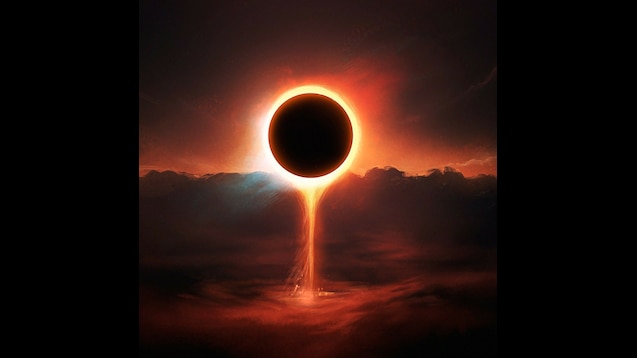
Her name is Lucatiel of Mirrah. She is like you, reckoning with a loss that is rapidly becoming inexpressible. The world which the game shows you, the world in which you move is a world that has already ended. Every kingdom falls, and every fire fades – the world of heroes will always inevitably collapse into ash. To put this another way, the Dark Souls games are structurally melancholic. This isn’t the same thing as depressing — for all their bleakness I think the games are fundamentally about overcoming. To put that another way, the point of the Dark Souls games is not to suffer, but rather to win. Despite that, they are melancholic. In her book Black Sun the psychoanalyst Julia Kristeva describes melancholia not as simple sadness. Rather, it is as an ‘abyss of sorrow’ where the subject loses the ability to mourn a lost object. Instead, they identify with the ‘Thing’ – an unsignifiable void: “an imagined sun, bright and black at the same time.” Or, as Solaire asks you in Dark Souls One:
“When I peer at the Sun up above, it occurs to me…What if I am seen as a laughing stock, as a blind fool without reason?”
There is something so frightening about finitude. Those moments of melancholia when we glimpse it in fragments — what’s wrong, someone asks. There are no words to say because the symbolic structure which gives that sense of wrongness coherence has collapsed.
“Loss of memory, loss of self. If I were told that by killing you, I would be freed of this curse… Then I would draw my sword without hesitation.”
What are we mourning? Or, perhaps to phrase the question another way, what are we made of? This is the point of melancholia, the loss of the external locus of self. It’s not an Object but rather an emptying.
For Kristeva, the melancholic is speechless, left “wandering in pursuit of continuously disappointing adventures and loves; or else retreats, disconsolate and aphasic, alone with the unnamed Thing”Don’t you dare go hollow, you are told so many times through the games. Hollowing is a kind of asymbolia, a slow loss of symbolic meaning, where language is reduced to mere half-remembered fragments and so self becomes unmoored.
Throughout all the games, NPCs gradually forget their names, their purpose, and why they are here. They laugh to themselves, half remembered ideas no longer a moment of loss but a memory of a memory. The self collapses because the words used to build that self have dissolved. Vendrick, stripped of his memories, almost naked and crownless. He staggers in a circle, dragging behind him a sword he now longer knows how to swing at you. The fire will fade, and the souls of old will reemerge. With Dark unshackled, a curse will be upon us… And men will take their true shape…
Kristeva puts it well, I think: “The melancholy thing interrupts desiring metonymy, just as it prevents working out the loss within the psyche.” Or, as the Slave Knight Gael asks you, at the end of all things in Dark Souls 3: “What, Still here? Hand it over, that thing, your dark soul.”
Kristeva again: “For those who are racked by melancholia, writing about it would have meaning only if writing sprang out of that very melancholia. I am trying to address an abyss of sorrow, a noncommunicable grief that at times, and often on a long-term basis, lays claims upon us to the extent of having us lose all interest in words, actions, and even life itself. Such despair is not a revulsion that would imply my being capable of desire and creativity, negative indeed but present. Within depression, if my existence is on the verge of collapsing, its lack of meaning is not tragic — it appears obvious to me, glaring and inescapable. Constantly, FromSoftware’s trilogy asks you to reckon with your own desires. What meaning have you written out from this? What do you want? To sit on a throne, in a world empty of life? To win lordship over a world that should have ended? To refuse endings, simply so the cycles of fire and dark will repeat themselves one more time? You get exactly what you want and what could be worse than that?
Signs are, Kristeva writes, ultimately about negation. Language is arbitrary but for the melancholic it is violently so. Words collapse into laughter, and then a drawn sword.
Even the mechanics stage this. Every death erodes progress; hollowing is literal. So, why bother remembering Lucatiel’s name? I think because finitude is frightening – the flames around the Dark Sign flicker as the last embers of humanity are extinguished. For Heidegger, being-towards-death was of the ultimate significance, but I prefer Sartre in this case. The dead are playthings for the living as he said in Being and Nothingness. “What then is death? Nothing but a certain aspect of facticity and of being-for-others—i.e., nothing other than the given. It is absurd that we are born; it is absurd that we die.” What matters is not the inescapability of the end — in fact, as the games make clear, endings constantly deferred is the worst kind of nightmare. Rather, what matters is the moment of choice that occurs in the (to put this in Sartrean terms) the moment of the look. For Sartre, the look of the other reduces oneself to the level of an object – to be looked at, without looking back is to be dead, to be an object robbed of freedom. Remember my name, look back at the other, who looks at you, reminding you of what awaits.
(Thanks to Xenogothic, for this piece that pointed me back to Kristeva’s book)


