
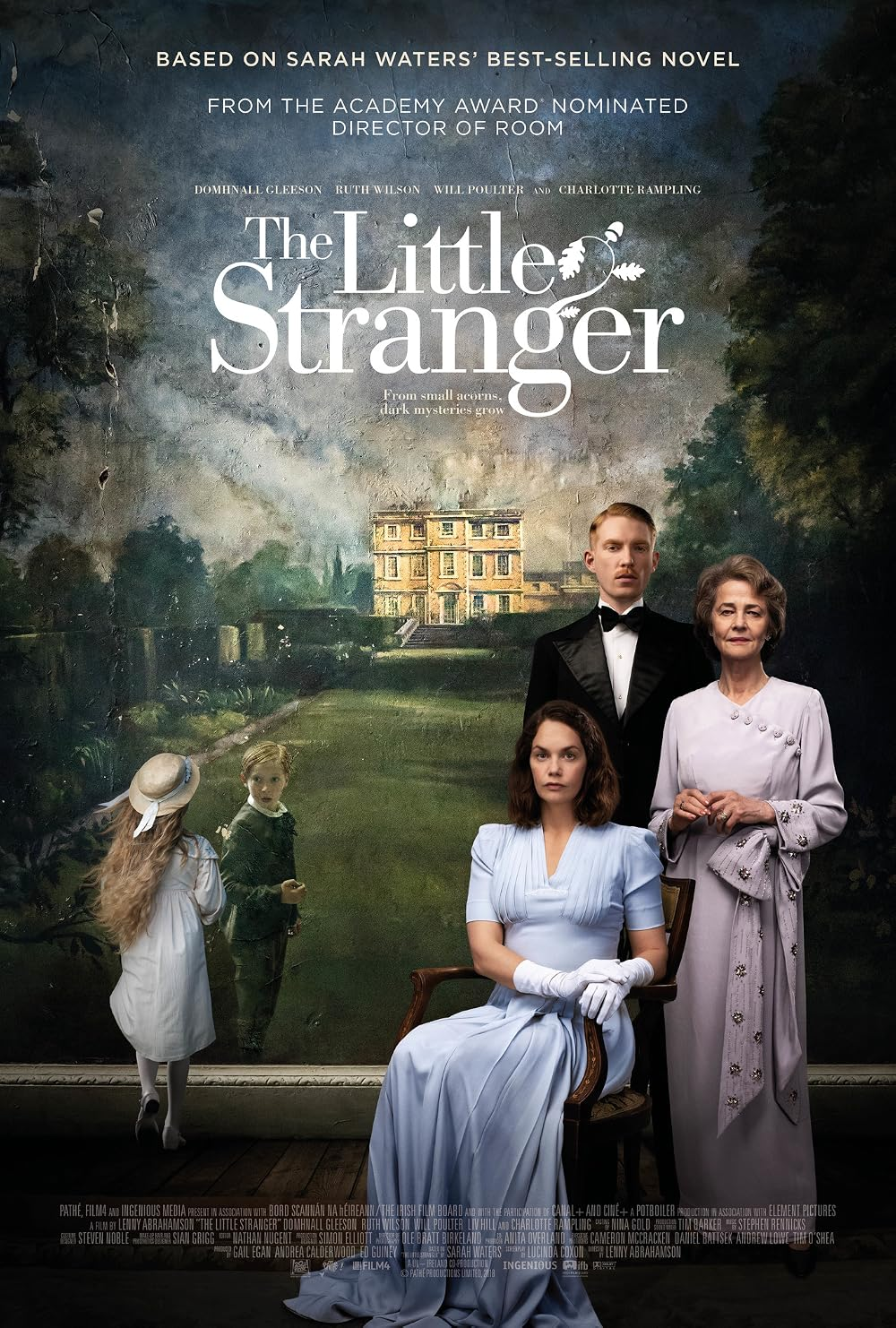
It’s been a while, but I thought it’s time to get back to writing about haunting houses in cinema. For a while, I’ve been meaning to write about The Little Stranger from 2018, a stylish, albeit rather restrained, adaptation of Sarah Water’s 2009 novel of the same name. Waters is well known and lauded as a pioneer of lesbian Gothic fiction, with a particular fondness for the nineteenth century, exemplified by Fingersmith and her debut Tipping The Velvet. The Little Stranger is neither explicitly sapphic nor set in the fin-de-siecle but rather is set immediately post world war two. The film follows a Dr. Faraday (Domhnall Gleeson) who becomes involved with the Ayres family who live in the increasingly decrepit Hundreds Hall. The family is made up of Mrs Ayres, (played with typical brilliance by Charlotte Rampling,) the heir apparent. Roderick, who is dealing with the mental and physical wounds of his time as a soldier (played by Will Poulter) and the eldest daughter, Caroline Ayres, played by the brilliant Ruth Wilson. Called out to the mansion to look in on a sick maid, Faraday thinks back to being invited out to the house in the interwar years for an “Empire Day Fete.” As a young boy he becomes infatuated with the house and the concomitant class signifiers of wealth, security and privilege. While exploring the house as a young boy he comes across Suki, the family’s first daughter who dies very soon after his first visit.
If the British class structure was able to stabilise itself in the immediate aftermath of World War One, the same can’t be said of the second world war. The film shows that the Ayres family have, in a sense, been left behind by history. The old social norms have ended, all that is solid has melted into air, and the old privileges of rank and position have dissolved thanks to a new Labour government. Faraday and his other medical colleagues are discussing the incoming nationalized health service, erasing the old ways of a doctor making house calls to clients who settle their bills one at a time.
By 1947, Hundreds Hall has become increasingly decrepit and the family are in dire economic circumstances, unable to get the house repaired because of their lack of credit and inability to pay outstanding bills and the whole family is socially isolated and quite clearly depressed. Roderick is deeply traumatised by his experience in the war — this has left him with both physical and emotional wounds, and he’s burdened by the precarious financial position the family has landed in. In a blow to the unity of the estate, Roderick decides they need to sell off a parcel of land, splitting the estate in two. The land goes to a real estate developer who wants to build new homes for the emerging middle classes, right next door to an old country house. Inside the house, the family are haunted – hearing noises from other parts of the house and tortured by a sense of impending doom. For Faraday these affectations are understood at first as a product of social collapse and alienation but as he spends more time with the family he medicalises what he sees. One by one, the family is either institutionalized (Roderick) or left dead.
Faraday makes one visit to the house, and then another, offering some social solace to the increasingly lonely Caroline, and out of a sense of social obligation he’s invited to a dinner party “to make up the numbers.” While there he becomes burningly aware of his own outsider status – and credit to Gleeson who gives a performance marked by stillness and disdain. It would be easy to see the film as almost romanticizing the British upper classes but all the aristocrats are basically tragic figures – left behind by historical forces they have no real way of understanding.
In contrast, Gleeson is powered with fury – apparently a staunch rationalist who responds with barely contained anger every time he’s reminded of his inability to transcend his own class position. To put this another way, if the film sees the upper classes as something deeply sad, ghosts barely clinging on within a society that has left them behind, Faraday is the archetypical member of the sharp-elbowed and upwardly mobile middle class. Educated out of any kind of relationship with his working class background (his mother works as a servant at Hundreds Hall, and Faraday seems deeply embarrassed to think about them) he slowly leaves Caroline completely isolated and dependent on him.
After Roderick burns one of the rooms in the house, Faraday insists he be institutionalized. Mrs Ayres becomes increasingly convinced that the ghost of Suki remains in the house. Enmeshed within her own memories she ends up killing herself, leaving Caroline alone. The film constructs a lot of its meaning through its editing — every time a supernatural event happens, Faraday is on hand to explain it away and to further inveigle himself into the house with which he’s so obsessed. Left alone, Caroline agrees to marry Faraday as a means of getting to move away from the house she sees as cursed. Faraday though, has no interest in leaving the house and right at the film’s close Caroline ends up dead, falling from one of the landings onto the main staircase. Again, the message is driven home through juxtaposition. One of the final scenes of the film is at the inquest into Caroline’s death and as the testimony unfolds we see Caroline walking through the house. “You”, she says, just before she falls and immediately there’s a cut back to Faraday. Ultimately, the film thinks of haunting as a manifestation of class position – the upper classes of the nineteenth century were collapsing into a kind of irrelevance by the end of the 1940s, becoming at best nostalgic echoes of a Britain that simply didn’t exist anymore. Faraday’s actions then can be understood as a kind of middle class neurosis, a desire for a security and certainty that the old class structures could provide. Property is no bulwark against a changing world, but as the very final shots of the film showcase neither is the obsessive desire to possess it.
Months later after Caroline’s death Faraday returns to the empty, for-sale Hundreds Hall, clutching keys Caroline once gave him. As he walks away, the camera lingers on the landing where she fell: standing there, watching him go, is the solemn figure of Faraday himself as a child — the little stranger who first entered the house decades earlier, still burning with a hunger for its security and status. Faraday gets what he always wanted, yet all that remains is bricks, mortar, and emptiness.


